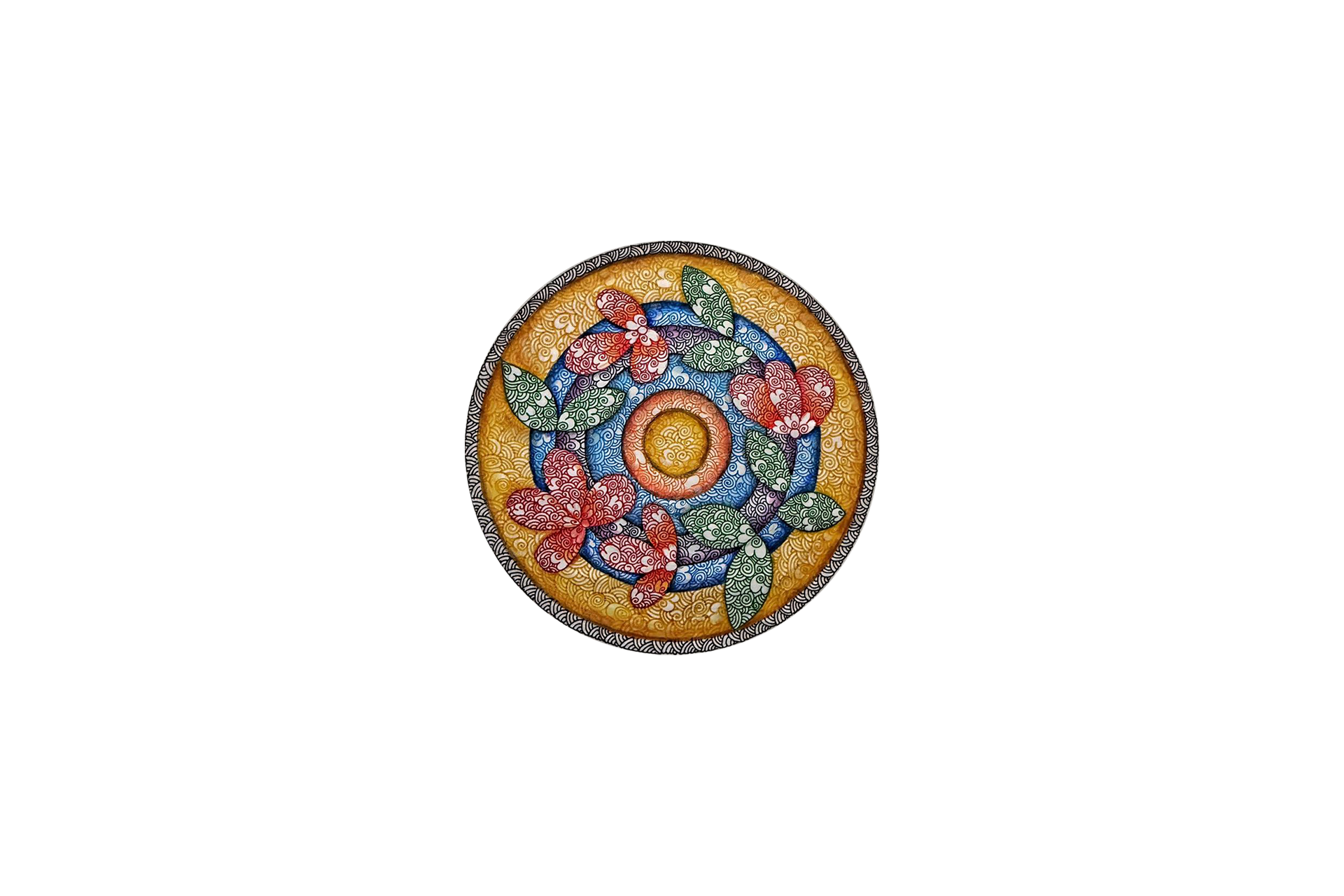
This mandala was not just something I created—it became something I understood.
As the form unfolded, a very clear Vedantic structure revealed itself. Not as theory, but as something I could directly relate to within my own experience.
I could see life happening in layers— and more importantly, I could see how these layers are connected. What began as separate observations slowly revealed a flow— from the outer expressions (8) to the inner processing (4), to the silent center (1).
 Prakriti — The Field of Experience (Ashta Jeevan Kshetra)
In Vedanta, the outer field of life is understood as Prakriti— the domain where all experiences arise.
In this mandala, it expresses through eight leaves the eight dimensions of living:
Through the Sharira (body), I experience sensations.
Through Prana (vital energy), I feel energy shifting.
Through Manas (emotional mind), feelings arise and dissolve.
Through Vichara (thoughts), I question and interpret.
Through Buddhi (intellect / decision-making), I navigate choices.
Through Sambandha (relationships), I connect and attach.
Through Karma (action), I act and perform.
Through Iccha (desire), I seek and grow.
This is life as it appears—dynamic, changing, always in motion.
These eight are not isolated—they constantly flow inward, moving from experience into interpretation.
What is lived outside begins to seek meaning inside.
 Antahkarana — The Inner Instrument (Antahkarana Chatushtaya)
In Vedanta, the inner processing system is called Antahkarana—the four flowers from mandala , the instrument through which these life experiences are understood.
• Manas — Emotional Mind which responds and reacts
• Buddhi — Intellect evaluates and decides
• Chitta — Memory Field which stores impressions
• Ahamkara — Ego Sense (Identity / “I”-maker) identifies—“this is happening to me ”
Here, experience becomes personal.
What is happening outside is shaped into “my experience” inside.
The eight expressions of Prakriti now move through these four filters, taking form as reaction, memory, identity, and decision.
As experiences pass through the inner instrument, they leave impressions in Chitta. These impressions become patterns that influence how we think, feel, and respond.
With repetition, these patterns become stronger—like a rhythm that keeps repeating itself. This is how Sanskara shapes our responses and continues the cycle. Yet, all of this is being observed— pointing to something beyond the cycle.
That is the Ātman — The Self (Drashta / Sakshi)
At the center of this entire movement, there is stillness. Not as absence, but as presence.
In Vedanta, this is Ātman— the Drashta (the Seer), the Sakshi (the Witness).
What became clear through this mandala is this:
The center is not part of the experience. It is not part of the processing.
Yet, without it— neither experience nor processing can be known.
When something happens in life (Prakriti), I am aware of it. When I think or react inside (Antahkarana), that too is known.
Even when Sanskaras arise as patterns from past impressions, they are also known.
What is being noticed keeps changing— but the one who is noticing remains constant.
The key insight is this:
Ātman is not outside this flow. It is the very reality because of which the flow is seen.
I may be experiencing life.
I may be reacting, thinking, deciding.
The eight continue to express.
The four continue to process.
The Sanskaras continue to influence.
But all of this is happening in the presence of something that does not change.
That is not separate from me.
That is what I am.
This is the movement of 8 → 4 → 1,
where the many resolves into the subtle, and the subtle rests in the One.
At the Golden center the Ātman remains as Drashta— unchanging, aware, and complete.
On the battlefield of Kurukshetra, Arjuna sees his own people standing against him and becomes overwhelmed—his body trembles, his mind is restless, and emotions take over. This is Prakriti (8), where life presents many experiences at once.
Inside, he begins to process it—confusion, attachment, fear, and doubt arise. This is Antahkarana (4), where experience becomes personal and heavy.
As this processing continues, his Sanskaras—past impressions of relationships, duties, and identities—begin to influence his reactions, making the situation feel even more intense and binding. Seeing this, Krishna does not change the situation but shifts Arjuna’s understanding, showing him that he is not just what he is experiencing, thinking, or conditioned by, but the one who is aware of all of it. This is Ātman (1)—the constant Seer.
With this clarity, Arjuna’s confusion settles; the situation remains the same, but his identification changes. He is no longer lost in experience, reaction, or conditioning—he becomes the Drashta. And in becoming the Drashta, his emotions no longer overpower him, his thinking becomes clear, and he is able to act with balance and purpose—engaging fully in life, yet remaining inwardly steady and free.
What I understand from this is that life’s situations, my reactions, and even my patterns (Sanskaras) will always arise, but I am not limited to them. By recognizing myself as the Drashta, I can stay steady within and respond to life with clarity instead of being carried away by it.
— Sonali Joshi